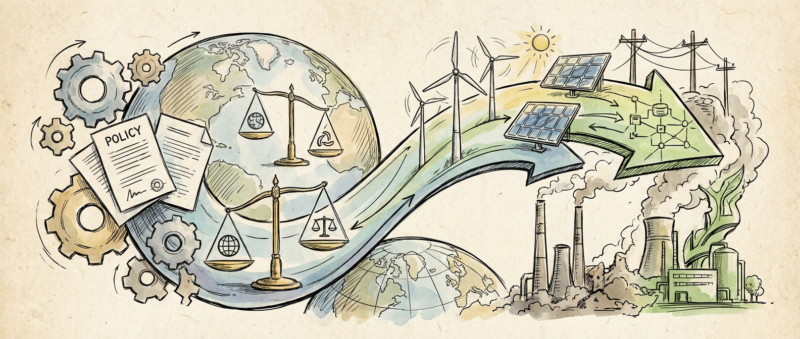
The Deceptive Simplicity of Energy Transition
When climate activists call for rapid decarbonization and fossil fuel executives push back citing economic realities, the resulting debate often misses a basic truth: energy transition isn’t just a technical challenge that needs better solar panels or more efficient batteries. It’s a massive restructuring of how modern industrial society works, touching every aspect of how we organize economic production, political power, and social life. The apparent simplicity of “replace fossil fuels with renewables” falls apart quickly when you look at the complex web of institutional arrangements, economic relationships, and political structures that have grown up alongside carbon-intensive energy systems over the past two centuries.

This complexity explains why climate policy frameworks keep falling short of their stated goals, regardless of which political party is in power or how urgent the scientific warnings get. The challenge isn’t mainly about political will or technology, though both matter. It’s that fossil fuel systems are deeply embedded in the broader structure of capitalist economies and democratic governments. If you want to understand why climate policy so often produces small adjustments rather than the big changes that climate science says we need, you have to understand this embedding.
The implications go way beyond environmental policy into the core of modern political economy. Energy systems shape labor markets, determine where economic opportunities exist, influence international trade, and affect how much money governments have to work with at every level. When we talk about energy transition, we’re talking about restructuring these relationships in ways that create winners and losers, redistribute political power, and challenge existing institutions. You can’t separate climate policy politics from these broader structural dynamics.

Institutional Lock-in and the Problem of Path Dependence
Energy systems have what political scientists call “path dependence”, where early choices constrain future options by creating self-reinforcing institutional structures. Our current energy infrastructure represents trillions of dollars in sunk costs, from power plants and pipelines to refineries and distribution networks. But the lock-in effects go far beyond physical infrastructure to include regulatory frameworks, professional expertise, financial instruments, and political coalitions that have organized around existing energy systems. Federal agencies like the Department of Energy and state public utility commissions built their institutional capabilities and standard procedures around managing fossil fuel systems, creating bureaucratic momentum that favors small changes over fundamental restructuring.
The financial sector shows perhaps the clearest example of institutional lock-in. Banks, pension funds, and insurance companies hold enormous quantities of fossil fuel assets on their balance sheets. The rapid devaluation of these assets that would come with swift decarbonization poses systemic risks to financial stability, creating powerful incentives for gradual approaches that preserve asset values while slowly transitioning to alternatives. This dynamic helps explain why climate stress testing and green finance initiatives, while important, tend to emphasize managed transition rather than rapid phase-out of carbon-intensive investments.
Political institutions make these challenges worse through their own path-dependent characteristics. The U.S. Senate’s structure gives outsized influence to rural states where fossil fuel production is concentrated, while the committee system allows key legislators from energy-producing regions to shape policy even when they represent minority viewpoints nationally. Campaign finance rules let fossil fuel companies maintain significant influence over electoral processes, not through crude corruption but through the perfectly legal provision of resources that candidates need to stay competitive. These institutional features aren’t bugs in the system. They’re structural characteristics that shape policy outcomes regardless of changing public opinion about climate change.
Economic Transition and the Geography of Political Power
Where economic activity happens under different energy regimes creates distinct patterns of political organization and representation. Fossil fuel systems tend to concentrate high-paying jobs in relatively few places, oil fields, coal mines, refining centers, while spreading environmental costs broadly across society. This concentration creates politically important groups with strong preferences for preserving existing energy systems, while the spread-out benefits of clean air and climate stability struggle to organize equivalent political pressure. The result is a classic collective action problem where concentrated interests have outsized influence over policy outcomes.
Renewable energy systems present a different but equally complex political geography. Solar and wind resources are more geographically distributed than fossil fuel reserves, potentially democratizing energy production and reducing the political influence of traditional energy companies. However, manufacturing renewable energy technologies remains concentrated in specific regions and countries, creating new forms of economic dependence and potential political vulnerability. China’s current dominance in solar panel production and rare earth element processing shows how energy transition can shift rather than eliminate geographic concentrations of political and economic power.
Regional economic transitions add another layer of complexity. Communities that have organized their economic development strategies around fossil fuel production face potential decline as these industries shrink. While “just transition” policies aim to address these challenges through retraining programs and alternative economic development, the historical record of successful regional economic transformation is mixed at best. The decline of manufacturing in the Rust Belt provides a sobering reminder that market-led transitions often leave communities behind, creating lasting political resentments that can shape electoral outcomes for decades. Climate policy frameworks must grapple with these distributional consequences or risk generating political backlash that undermines long-term sustainability goals.
Regulatory Complexity and Multi-Level Governance
Energy regulation in the United States operates across multiple levels of government with overlapping jurisdictions and conflicting authorities. Federal agencies regulate interstate electricity transmission and pipeline safety, while state public utility commissions oversee retail electricity markets and renewable energy standards. Local governments control land use decisions that affect siting of energy infrastructure, while regional transmission organizations coordinate electricity markets across state boundaries. This fragmented authority structure creates numerous veto points where opponents of change can slow or block energy transition initiatives, even when there’s broad support for climate action at the national level.
The technical complexity of electricity systems makes these governance challenges worse. Unlike other commodities, electricity can’t be stored at scale and must be balanced in real-time between supply and demand. Integrating variable renewable energy sources requires sophisticated coordination mechanisms and significant investments in grid flexibility, storage, demand response, and transmission infrastructure. These technical requirements often clash with existing regulatory structures designed for centralized, controllable fossil fuel power plants. Utility regulators used to setting rates based on capital investments in physical infrastructure struggle to adapt to business models based on distributed resources and digital platforms.
International dimensions add yet another layer of complexity. Energy markets are increasingly global, with natural gas traded worldwide and renewable energy supply chains spanning multiple continents. Climate policy in one jurisdiction affects energy prices and investment flows elsewhere, creating spillover effects that can undermine policy effectiveness. Carbon border adjustments represent an attempt to address these leakages, but they risk triggering trade disputes and may face legal challenges under international trade law. The absence of binding international agreements with enforcement mechanisms means that climate policy remains primarily a matter of domestic politics, even though the problem requires global coordination.
Strategic Implications for Climate Policy Design
Understanding these structural dynamics suggests several important considerations for climate policy design. First, effective policies must account for path dependence and institutional lock-in by creating new groups and economic interests that favor continued decarbonization. Feed-in tariffs and renewable portfolio standards succeed partially because they create economic beneficiaries, renewable energy developers, equipment manufacturers, landowners receiving lease payments, who lobby for policy continuation and expansion. Industrial policy approaches that build domestic clean energy manufacturing capacity do similar constituency-building work while addressing economic transition challenges.
Second, addressing distributional consequences isn’t just morally important but politically necessary for maintaining long-term policy support. This requires moving beyond market-based mechanisms toward more active government intervention in managing economic transitions. Place-based policies that channel clean energy investments toward fossil fuel-dependent communities can help build cross-regional coalitions for climate action while addressing legitimate concerns about economic displacement. Public ownership of energy infrastructure may be necessary in some cases to ensure that transition benefits flow to affected communities rather than external investors.
The complexity of these structural challenges shouldn’t make us despair or do nothing. Rather, it suggests the need for climate policy frameworks that are both ambitious in scope and realistic about implementation challenges. This means designing policies that work with rather than against existing institutional structures while gradually creating pressure for deeper structural reforms. It also means recognizing that climate policy is fundamentally about power, who has it, how they use it, and how it might be redistributed to support sustainable energy systems.
These structural dynamics will keep evolving as energy transition proceeds, creating new political possibilities while closing off others. Understanding these changes requires ongoing analysis of how technological developments, economic shifts, and policy interventions interact with existing institutional arrangements. What aspects of energy transition politics do you find most significant in your own community or region of interest?