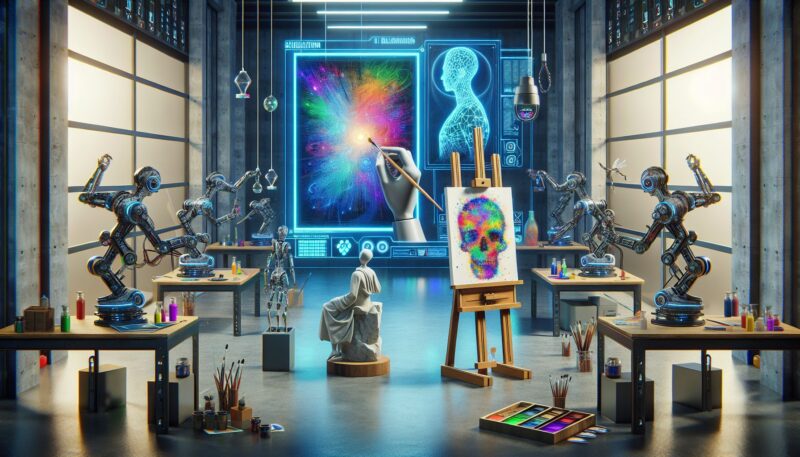
Hey tech explorers! Today, let’s dig into the weird world where neural networks paint, sketch, and compose — where Artificial Intelligence crashes into the Creative Arts. This isn’t some distant sci-fi fantasy but something happening right now, and it’s changing how we think about art.
Art and Algorithms: A Surprising Symbiosis
When we talk about AI in creative arts, it might sound like a bizarre idea at first. I mean, letting a computer create art? What sorcery is this? But the reality is, AI is already elbow-deep in the creative world, and it’s blowing our minds.
Take OpenAI’s GPT-3, for instance. It’s been making waves by writing poetry and screenplays, copying the style of cultural icons. This tool spits out coherent stories from mere keywords — stories that have left me (and many others) quite frankly, astounded. Meanwhile, neural networks like DALL-E and Midjourney have been generating some wild imagery, creating visuals that would challenge even seasoned artists.
Is it intimidating? Heck, yes. But it’s also exciting! Imagine collaborating with an AI that helps you overcome creative blocks or acts as a virtual muse sparking unthinkable ideas. Personally, I’ve tried using some of these tools to break my writer’s block. I won’t lie; sometimes it feels like having a very quirky, eccentric co-writer.
The Technology Behind the Curtain
So, how do these AI artists actually do it? It all comes down to machine learning models that have been fed mountains of data. Neural networks are trained with vast databases of literature, artworks, and music. They learn patterns, styles, and the subtleties that make creations uniquely human (ironically).
This is where Big Data comes into play. The more data these AI models consume, the more sophisticated their output becomes. But it’s not just about data; it’s also about the algorithms driving these creations. Think of them like brushes and colors in the hands of an artist.
What’s truly fascinating is how these algorithms evolve to express ideas. They’re not copying existing works but creating something new. It’s not just mimicry; it’s originality in its own right. The philosophical implications are vast and somewhat mind-boggling. Can machines truly create? Can they feel inspiration?
New Paradigms in Art and Creation
The art world, as you’d expect, has mixed feelings about this techno-renaissance. There’s a camp that’s excited about the endless possibilities — imagine art exhibits where human and AI artists collaborate. Then there are those skeptical of AI’s potential to truly “understand” art.
It’s a little like the introduction of photography, which initially freaked out painters but eventually found its own artistic niche. I believe AI will also carve out its place, complementing rather than replacing human creativity.
Museums like the Louvre or MoMA might soon host AI-generated masterpieces. There could be entirely new art categories or even genres emerging. Think “Neural Impressionism” or “Cognitive Jazz”. These aren’t just imaginative terms but potential realities.
Challenges and Ethical Considerations
Of course, it’s not all rainbows and neural networks — there are ethical puzzles at play. Ownership of AI-generated art is a murky area. Who holds the rights: the programmer, the user, or the algorithm itself?
Then there’s the concern about artistic homogenization. While AI has the potential to generate fresh perspectives, an over-reliance could lead to a loss of human touch in art, the kind that moves us in profound, inexplicable ways.
We need to approach AI in the arts responsibly, integrating it not as a replacement for artists, but as an enhancer of human creativity. Imagine if Van Gogh had an AI to play with his dynamic skies or Mozart an AI orchestra to test symphonies in real-time. The possibilities are boundless but must be approached thoughtfully.
What Comes Next in Art
As we cautiously welcome AI into the creative arts, there’s genuine excitement about what lies ahead. From AI-generated movie soundtracks to paintings, literature, and beyond, this integration is less about replacing artists and more about expanding the creative toolkit.
Recently, I collaborated with an AI to compose a short story — the narrative arc took unexpected turns I’d never even considered. It was thrilling and slightly surreal. This firsthand experience hammers home the point: AI isn’t here to snatch the brush from our hands; it’s offering us a bigger canvas.
So, to all the artists, programmers, and curious minds out there, let’s embrace this new chapter with open arms and an open mind. We’re not just watching history unfold, we’re helping write it. And that feels pretty special to be part of.