The Quiet Revolution in State Capitols
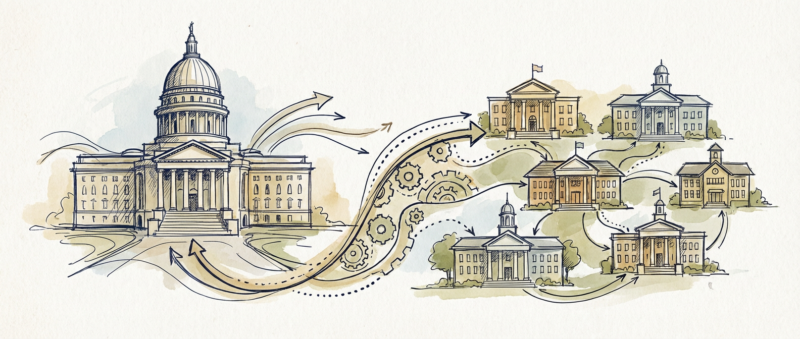
While national politics captures headlines and social media attention, something major is happening in American governance that most people aren’t noticing. State legislatures are systematically expanding their authority, not through dramatic constitutional amendments or federal mandates, but through careful policy innovations, strategic preemption of local governments, and increasingly sophisticated institutional capacity building. This transformation might be the most important realignment of political power in the American federal system since the New Deal era.
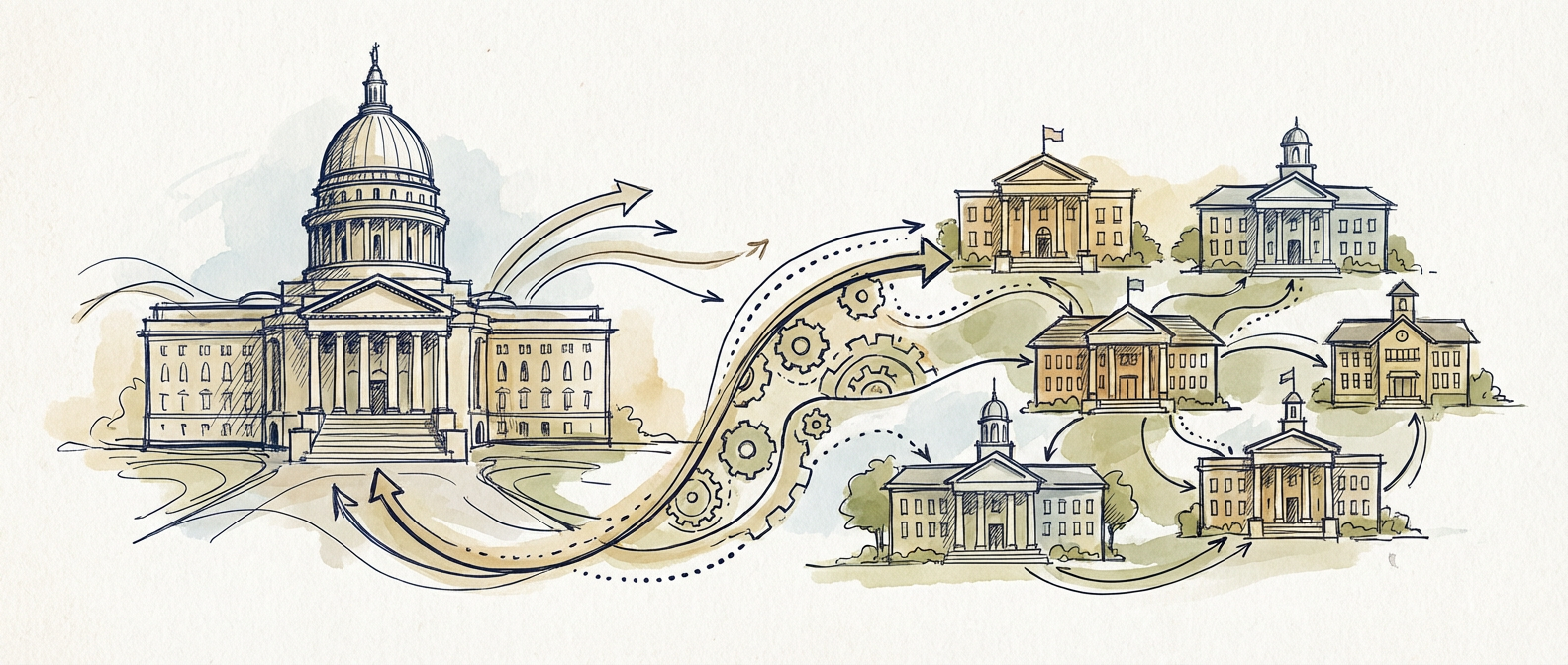
The conventional narrative suggests that state governments are primarily laboratories of democracy, testing policies that may eventually scale to the federal level. This framing contains some truth, but it misses a more complex reality. State legislatures aren’t merely experimenting with governance. They’re actively reshaping the balance of power between federal, state, and local authorities in ways that may prove irreversible. The implications reach far beyond partisan politics into fundamental questions about democratic representation, policy effectiveness, and the future structure of American federalism.
Understanding this shift requires examining three connected developments: the professionalization of state legislative institutions, the strategic use of preemption authority to constrain local governments, and the emergence of interstate policy coordination networks that operate largely outside traditional federal oversight. Each is a significant departure from historical patterns of state governance. Together they suggest a new model of state power that challenges existing assumptions about American political structure.

The Professionalization Paradox
Modern state legislatures look nothing like the part-time, amateur institutions of the mid-20th century. Today’s state lawmakers increasingly work year-round, supported by professional staff, sophisticated research capabilities, and substantial budgets. This professionalization has created legislative bodies capable of addressing complex policy challenges with technical expertise that often exceeds that available to federal agencies or local governments. The National Conference of State Legislatures reports that total state legislative staff nationwide has grown by over 300% since 1979, while session lengths have expanded dramatically across most states.
But here’s where it gets interesting. This institutional development creates a paradox. Greater professional capacity enables more effective governance, but it also generates institutional incentives for expansion of state authority. Professional staff seek meaningful work that matches their expertise. Legislative leaders build careers on significant policy achievements. Committee chairs develop specialized knowledge that demands application. These dynamics create internal pressure for states to assume greater responsibility across policy domains, regardless of whether such expansion actually serves the public interest.
The result is a systematic bias toward state-level policy solutions, even in areas where local governance might work better or where federal coordination would better serve interstate concerns. California’s environmental regulations, Texas’s energy policies, and Florida’s education reforms all reflect sophisticated state-level policy development that crowds out alternative approaches. While these policies may succeed on their own terms, they demonstrate how institutional capacity shapes policy choices in ways that go beyond simple partisan preferences or ideological commitments.
Preemption as Strategic Governance
The most visible sign of expanding state power appears in preemption legislation that explicitly prohibits local governments from adopting certain policies. Since 2010, states have enacted thousands of preemption measures covering everything from minimum wage laws and rental regulations to environmental standards and public health measures. This is a real shift from traditional state-local relations, where states typically provided frameworks within which localities could exercise discretionary authority.
Contemporary preemption operates according to different logic. Rather than establishing minimum standards or procedural requirements, states increasingly mandate specific policy outcomes and prohibit local variation. Wisconsin’s prohibition on local broadband initiatives, North Carolina’s restrictions on municipal energy programs, and Arizona’s limitations on local gun regulations all exemplify this approach. The common thread involves state governments using their constitutional authority to prevent local policy innovation, effectively reversing the traditional relationship between state and local experimentation.
This strategic use of preemption accomplishes multiple purposes beyond immediate policy objectives. It allows state politicians to claim credit for addressing constituent concerns without developing comprehensive state-level solutions. It prevents local governments from developing alternative policy models that might challenge state approaches. Most importantly, it establishes precedents for state authority that can later be expanded into adjacent policy domains. The long-term effect is systematic centralization of policy authority at the state level, regardless of whether such centralization improves governance outcomes.
Critics argue that aggressive preemption undermines democratic responsiveness by preventing communities from addressing local concerns through local institutions. Supporters contend that uniform state policies prevent harmful regulatory competition and ensure equal treatment across jurisdictions. Both perspectives have merit, but the debate often misses the broader structural implications. Preemption isn’t simply about individual policy outcomes. It’s a fundamental redefinition of the relationship between different levels of government within the federal system.
Interstate Networks and Shadow Federalism
Perhaps the most underappreciated aspect of expanding state power involves the emergence of interstate coordination mechanisms that operate independently of federal oversight. Organizations like the American Legislative Exchange Council, the State Innovation Exchange, and various interstate compacts create policy development and coordination networks that effectively constitute a parallel system of intergovernmental relations. These networks enable states to develop coordinated policy approaches without federal involvement, creating what scholars increasingly recognize as “shadow federalism.”
The Interstate Medical Licensure Compact exemplifies this phenomenon. Rather than waiting for federal action on physician mobility across state lines, participating states created a mutual recognition system that makes professional licensing reciprocity easier. Similar compacts address nurse licensure, emergency management coordination, and even climate change policy. Each is an example of state governments collectively assuming responsibility for interstate coordination traditionally managed through federal agencies or interstate commerce regulation.
These developments challenge fundamental assumptions about American federalism. The constitutional system assumes that interstate coordination occurs either through federal government mediation or through formal interstate compacts subject to congressional approval. Contemporary state networks operate largely outside these frameworks, creating policy coordination mechanisms that bypass federal oversight while generating legally binding commitments among participating states. The result is a form of cooperative federalism that excludes federal participation, fundamentally altering the balance of power within the American system.
Implications for Democratic Governance
The expansion of state legislative power raises serious questions about democratic representation and accountability. State governments operate with less media scrutiny than federal institutions but more resources and authority than local governments. This positioning enables significant policy influence while limiting public awareness of state-level decision-making processes. Voter turnout in state legislative elections consistently lags behind federal contests, creating a democratic deficit precisely where governmental power is increasing most rapidly.
Moreover, the geographic basis of state representation may prove increasingly problematic as states assume greater policy authority. State boundaries reflect historical accidents rather than contemporary economic, social, or cultural patterns. California contains nearly 40 million residents with dramatically different interests and circumstances. Wyoming’s 580,000 residents exercise the same state-level authority as their California counterparts. As states become more powerful relative to federal and local governments, these disparities in representation become more consequential for American democracy.
The question isn’t whether expanding state authority is a positive or negative development, but whether current institutional arrangements can effectively manage the consequences. State governments are assuming greater responsibility for policy coordination, economic regulation, and social provision without corresponding increases in democratic accountability or institutional oversight. This creates potential for both policy innovation and democratic dysfunction, depending on how effectively states manage their expanding authority.
These trends deserve sustained attention from citizens, scholars, and policymakers who care about effective democratic governance. The transformation of state power isn’t occurring through dramatic constitutional changes or highly visible political contests, but through gradual institutional development that may prove more consequential than the federal political dramas that dominate public attention. Understanding this transformation is essential for anyone seeking to comprehend the future of American governance.